How to Select the Right Spring Anti-Vibration Mount for Your Application
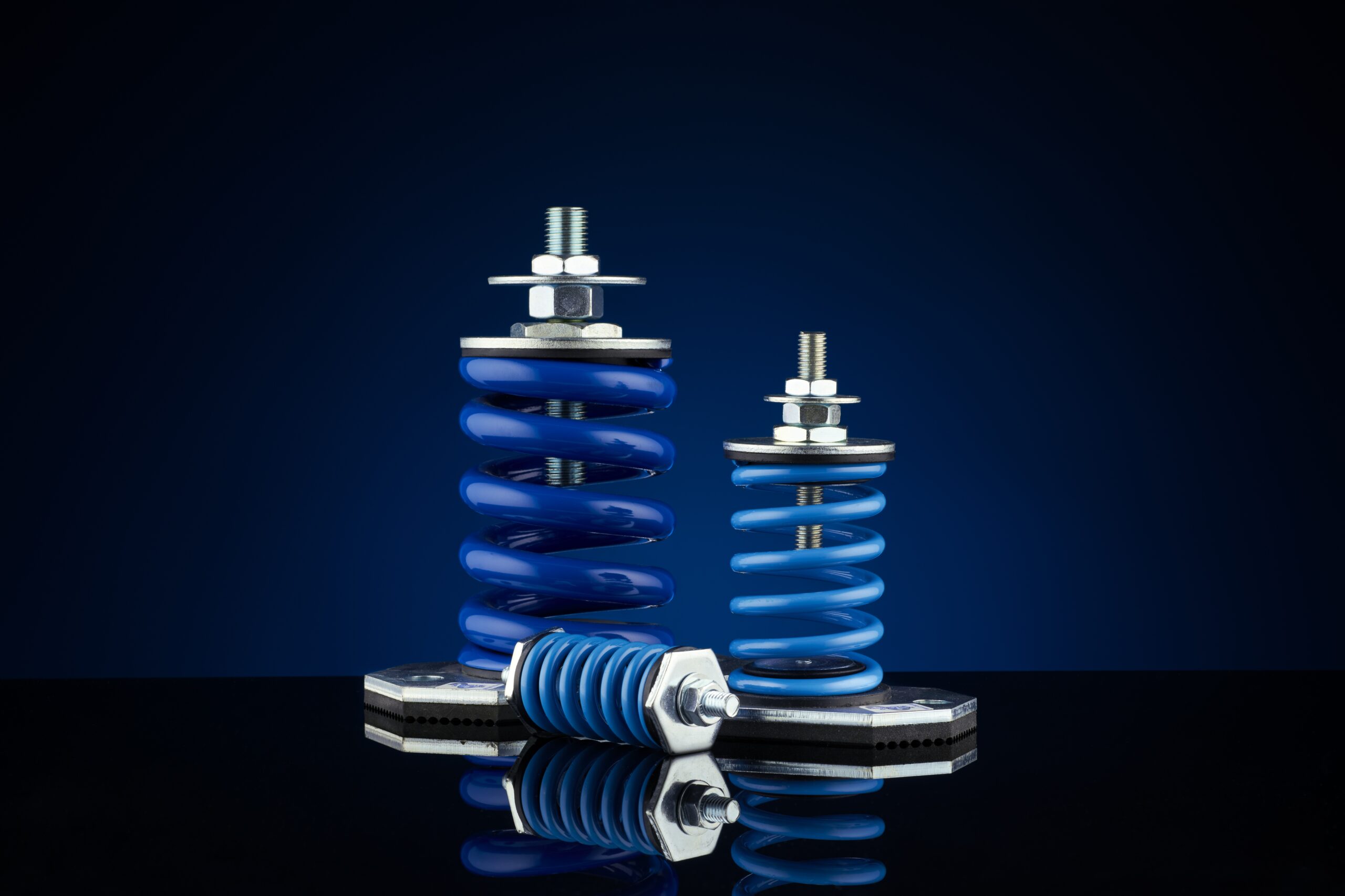
Most vibration problems don’t show up on day one. A generator gets installed, everything seems fine, and then six months later there’s a complaint about noise on the floor above. Or a maintenance engineer notices uneven deflection, with one mounting point sitting lower than the others. More often than not, the root cause can be traced back to the selection stage: mounts chosen on machine weight alone without much thought given to point loads, running frequency, or the operating environment.
This guide explains how to select the right spring anti-vibration mount for your application.
What Are Spring Anti-Vibration Mounts?
Spring anti-vibration mounts use metal springs to support machinery and reduce the amount of vibration transferred from the equipment into the floor, frame, or surrounding structure. Effective isolation occurs when the natural frequency of the spring-mounted system is well below the forcing frequency of the equipment, reducing the transmission of vibrational energy into the supporting framework. This may be a concrete plinth, a steel deck, or a floor several storeys up
Spring Mounts vs Rubber Mounts: When Each One Is Right
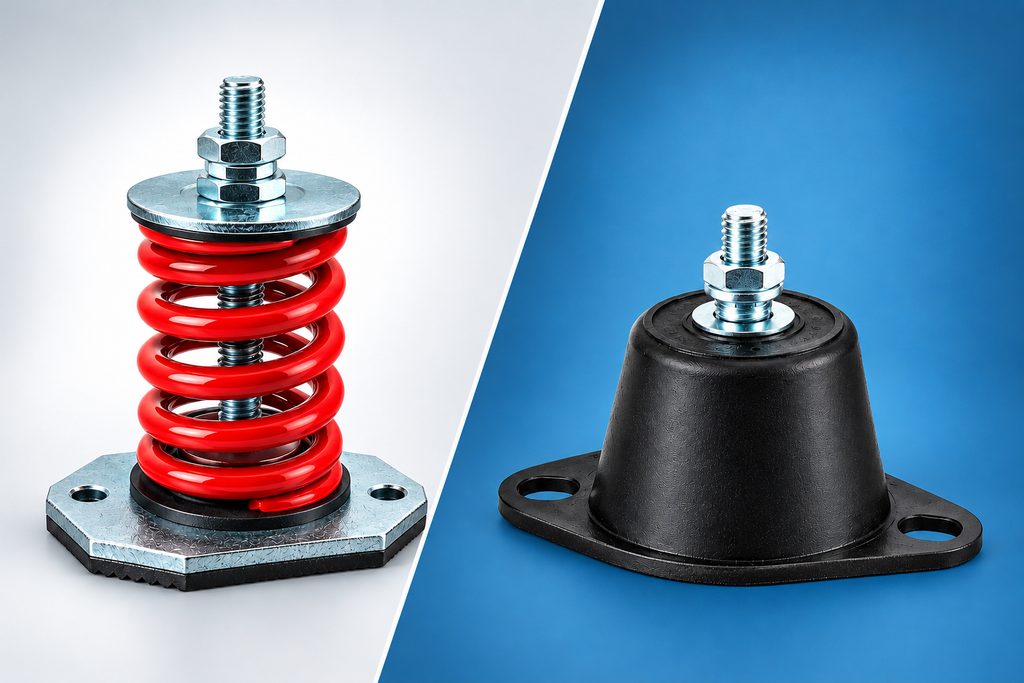
Rubber isolators provide inherent damping, helping to control resonance by absorbing vibration energy and limiting amplification. Spring mounts, on the other hand, can provide greater static deflection, allowing them to achieve higher isolation efficiency.
The choice between the two is not simply a matter of high-frequency versus low-frequency vibration. The appropriate isolator depends on factors such as the required deflection, forcing frequency, natural frequency, and characteristics of the equipment. For our TSC mounts used in marine and industrial applications, the two are combined. The steel spring provides high isolation efficiency, while a rubber element provides damping.
Key Factors in Selecting the Right Spring Mount
This is where a considerable number of selection errors occur, and it’s usually the first thing to double-check.
Equipment Weight and Load Distribution
Start with the equipment’s total operating weight, not simply its nominal or dry weight. Tanks, fluid-filled units, and ancillary equipment must be taken into consideration. If the equipment has an offset centre of gravity, it may be necessary to use uneven mount spacing with identical mounts or, where mount positions are fixed, select mounts with different rated capacities. Specifying identical spring mounts without checking the centre of gravity relative to mount positions can result in some mounts being overloaded and others underloaded.
Natural Frequency and the Forcing Frequency of Your Equipment
The natural frequency and forcing frequency are key to calculating isolation efficiency. Effective isolation requires the mount’s natural frequency to be sufficiently below the equipment’s forcing frequency. If the two frequencies are too close, resonance will occur, resulting in vibration amplification.
For equipment such as diesel generators and reciprocating compressors, the dominant forcing frequencies need to be considered when selecting the spring. These may be influenced by operating speed, firing frequencies, and harmonics rather than RPM alone. The spring mount therefore needs to be selected according to the relevant forcing frequencies and the required isolation performance.
Static Deflection Requirements
Static deflection is how far the spring compresses under the equipment’s own weight. In general, lower dominant forcing frequencies typically require greater static deflection to achieve the required isolation performance. Even where two machines have the same point loads, a spring suitable for one may not achieve adequate isolation for the other if it operates at a lower forcing frequency.
Operating Environment
Marine, offshore, and outdoor installations can expose mounts to weather, salt spray, and, in some cases, elevated temperatures. Corrosion-resistant materials, protective coatings, and suitable housings can all make a real difference to service life in these settings. Even if a mount is correctly selected for the applied load and operating frequency, a design that is unsuitable for the environment can lead to deterioration or reduced service life.
Open Spring Mounts: Restrained and Unrestrained Designs
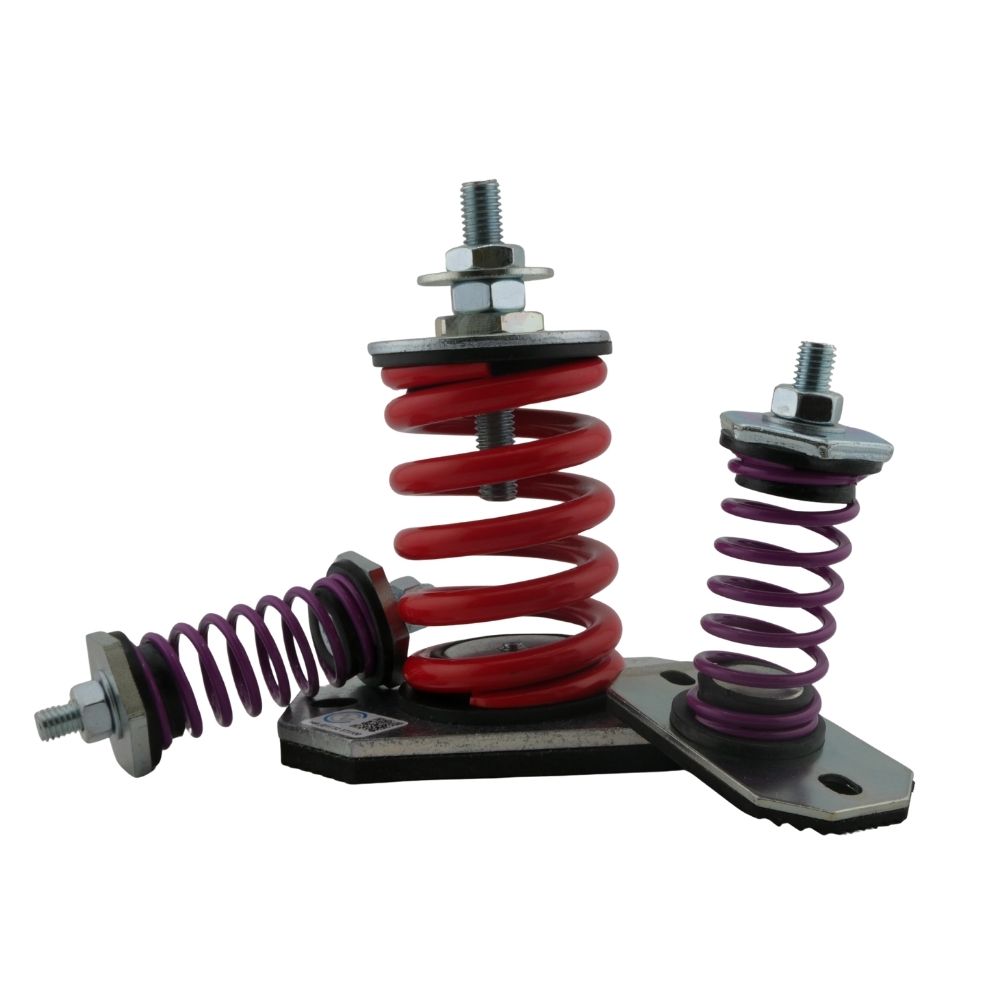
Open, free-standing designs are relatively simple and easy to inspect. Open spring mounts paired with dampers are ideal for low-frequency generators located in enclosed spaces where noise and movement need to be controlled. Our open restrained springs are ideal for machinery with large weight variations, such as chillers and cooling towers, as they are designed to limit vertical movement. They are also well suited to rooftop installations and high‑rise buildings, where the lateral restraints prevent excessive movement during wind loads.
Spring Mounts by Application
HVAC, chillers, cooling towers, and generators: Rooftops and plant rooms are common locations for spring-isolated equipment, particularly where structure-borne vibration could affect occupied spaces below. Enclosed spring mounts and open spring mounts are both widely used on these types of equipment.
Marine engines and deck machinery: Vessels are subject to constant motion, high loads, and harsh marine environments. Christie & Grey offers a range of mounts designed for these conditions, including TSC combined spring and rubber isolators.
Industrial machinery: Pumps, compressors, centrifuges, and other rotating equipment often require spring mounts capable of supporting continuous operation while maintaining effective vibration isolation throughout their service life.
Spring mount maintenance
Maintenance requirements vary depending on the type of mount, operating environment, and application. Periodic inspection may be required, particularly in marine, outdoor, or critical installations, to check for corrosion, uneven loading, damage, or other changes that could affect performance. Please refer to our in-service maintenance instruction data sheets for details.
Conclusion
Successful vibration isolation depends on selecting the right mount for the application. Taking factors such as point loads, operating conditions, and isolation requirements into account from the beginning can help prevent unnecessary cost, delays, and rework. For assistance selecting spring anti-vibration mounts for your application, contact Christie & Grey’s technical team.
