Trident / Triton – Rotor-Tug
Key Details
Operator: Seabulk Towing
Main Engines: 3 No. Caterpillar 3512C propulsion engines
Engine Operating Speed: 1200 rpm
Calculated Vertical Isolation Efficiency: 96+%
Industry: Marine & Offshore solutions
Mountings: TSC T10 isolators
The Vessel
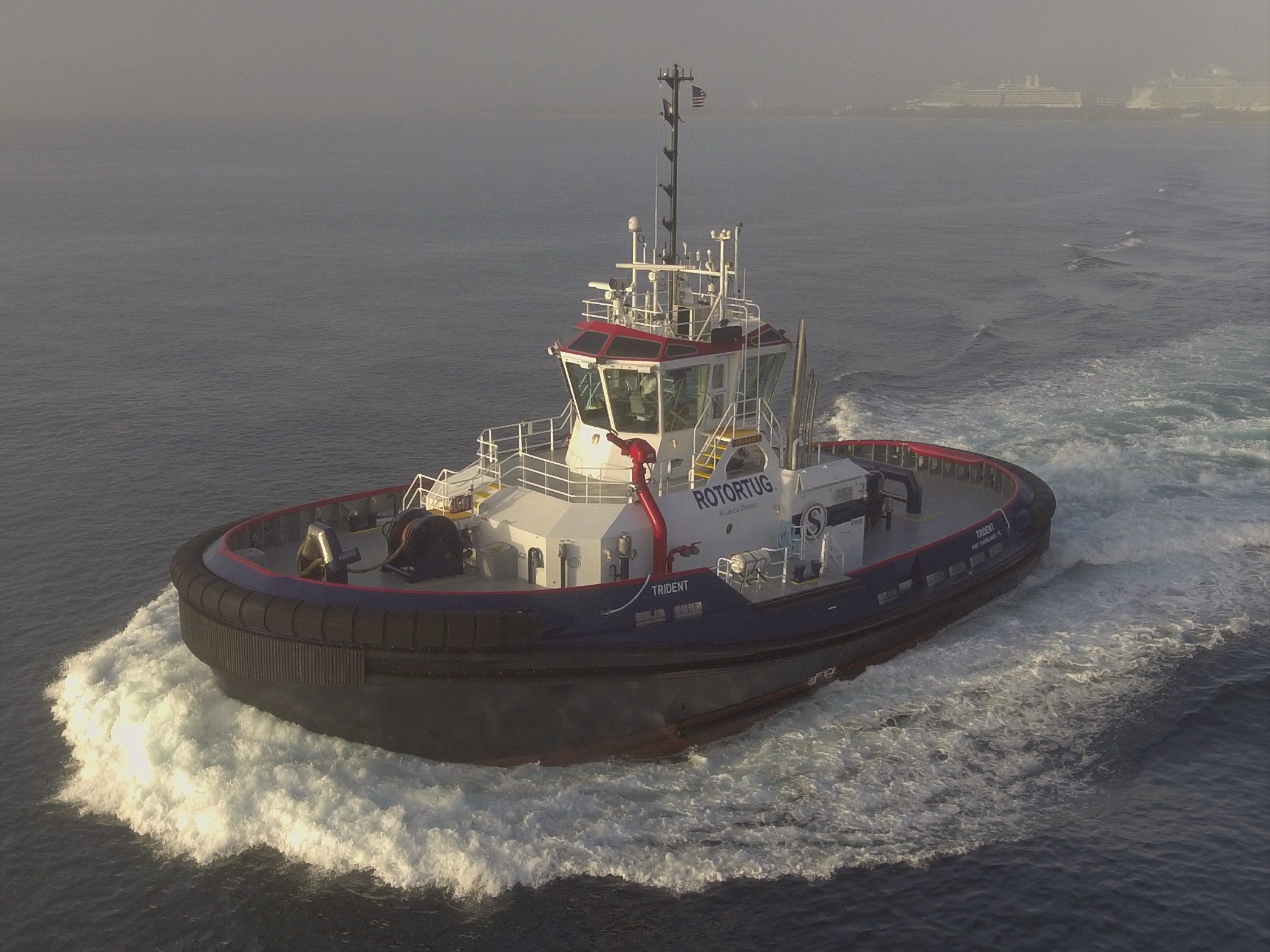
Designed by Robert Allan, the Trident Rotortug was built by Master Boat Builders with the goal of being the most manoeuvrable towing vessel in the United States. The vessel was delivered in January 2017 and entered service a month later, marking the first in a series of three tugs built for Seabulk.
Named after the weapon favoured by the sea god Poseidon, the second sister tug, Triton, is named after Poseidon’s messenger, with the third, Trinity, delivered later that year.
Seabulk’s rationale for introducing the design to the US was that Rotortugs represent the next generation of highly manoeuvrable tugs, making them ideal for LNG export terminals and other applications demanding safe moorings.
The Challenge
The challenge was to provide superior isolation performance for the Thompson Tractor-supplied Caterpillar 3512C marine propulsion engines, allowing the vessel to operate at optimum performance and capability.
The Solution
We selected our TSC T10 isolators for compatibility with the Centa CX-72 coupling, providing a vertical isolation efficiency in excess of 96%. Each of the port, starboard, and aft engines were individually analysed using our in-house six-degrees-of-freedom programme to ensure that all operating conditions were considered and the optimum selection was provided.
Similar Vessels
Z‐drive Vessels
American Commercial Lines ‐ Caterpillar C32
- American Way
- American Dream
- American Spirit
- American Hero
- American Century
- American Progress
- American Life
- American Reliance
- American Skill
- American Valor
- Jeff Kindl
Wilmington Tug – Cummins QSK38
- Wilmington Tug > Home – Wilmington Tug, Inc.
Explore Our Marine Isolation Solutions
Ready to improve vibration isolation on your vessel? Contact Christie & Grey to discuss engine mounting solutions tailored to your propulsion setup.
FAQs
What is vibration isolation efficiency?
Isolation efficiency measures how much engine-generated vibration is prevented from transferring into the vessel’s hull and structure. Higher efficiency (in this case, 96+%) reduces noise, structural fatigue, and wear on onboard equipment, while improving crew comfort. It also helps the propulsion system operate closer to its intended performance, which matters on a vessel purpose-built for maximum manoeuvrability like the Trident Rotortug.
What is a six degrees of freedom analysis?
It’s an engineering method that evaluates movement and forces along three linear axes (surge, sway, heave) and three rotational axes (roll, pitch, yaw). This allows engineers to model real-world vessel motion and ensure isolators perform reliably under all operating conditions, not just in a static state.
Can TSC T10 isolators be used with other engine and coupling combinations?
Yes. TSC T10 isolators are engineered to be paired with a range of couplings and engine types depending on the application. Each project is assessed individually to match the isolator and coupling to the specific vessel, engine, and performance requirements.
Are these isolation solutions suitable for other vessel types, not just Z-drive tugs?
Yes. While this case study covers a Z-drive Rotortug, similar isolation principles apply across commercial marine vessels, including workboats, ferries, and other towing vessels.
